
7 Common Math Mistakes and How to Avoid Them
Catch the error type before it repeats.
Error check
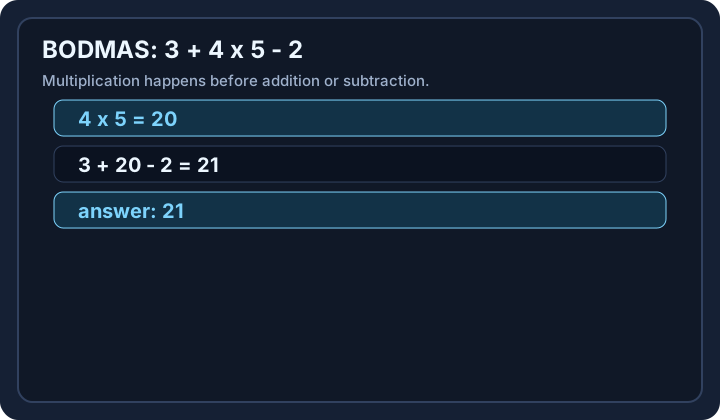
Handle operation order before speed
A fast answer is only useful after multiplication and division are placed correctly.
- 1Mark multiplication and division first.
- 2Evaluate those pieces.
- 3Return to addition and subtraction from left to right.
Common slip
Do not run left to right until the higher-priority operations are already simplified.
Sign check
Compute size first, then apply the sign
For one negative factor, the product is negative after the positive size is known.
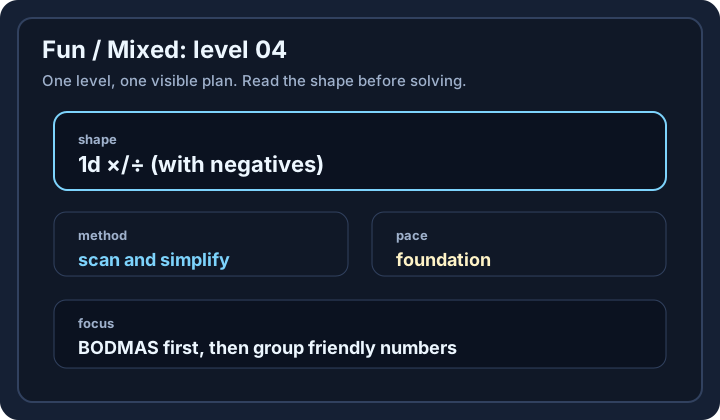
- 1Ignore the sign for one breath.
- 2Compute 8 x 6 = 48.
- 3Apply one negative sign.
Fast check
One negative makes a negative answer; two negatives make a positive answer.
Most calculation errors are not random. They recur at the same decision point: choosing an operation, carrying a sign, aligning a place value, or interpreting a unit. Name the error and attach one small check to that point.
1. Ignoring the order of operations
Worked example: In 2 + 3 x 4, multiply first: 3 x 4 = 12, then add 2. The result is 14, not 20.
Prevention: Mark multiplication, division, powers, or grouped expressions before calculating. Operations at the same priority are handled from left to right.
2. Losing a negative sign
Worked example: -8 x 6 = -48, while -8 x -6 = 48. One negative factor gives a negative product; two give a positive product.
Prevention: Decide the sign before calculating the magnitude. On a number line, check whether the result should sit above or below zero.
3. Distributing to only one term
Worked example: 3(x - 4) = 3x - 12, not 3x - 4. The factor outside the parentheses multiplies every term inside.
Prevention: Draw a short arrow from the outside factor to each term. Substitute a simple value, such as x = 5, to verify both forms produce the same result.
4. Adding fraction denominators
Worked example: 1/3 + 1/4 is not 2/7. Using denominator 12 gives 4/12 + 3/12 = 7/12.
Prevention: Ask whether the pieces have the same size. Only the numerators can be combined after the fractions use a common denominator.
5. Misplacing a decimal
Worked example: 3.6 x 0.4 has two decimal places across the factors, so the product is 1.44, not 14.4.
Prevention: Estimate first. Since 3.6 x 0.4 is less than 4 x 0.5 = 2, any answer above 2 is impossible.
6. Using the wrong percentage base
Worked example: A price rises from $80 to $100. The increase is $20, and the original price is the base: $20 / $80 = 25%. Dividing by the new price would incorrectly give 20%.
Prevention: Write the relationship in words before the fraction: change / original for percent change, or part / whole for a share.
7. Dropping units or rounding too early
Worked example: Three 1.25 m boards have total length 3 x 1.25 m = 3.75 m. Writing 3.75 without the unit leaves the result ambiguous. Rounding each board to 1 m first would produce a poor total of 3 m.
Prevention: Carry units through the calculation and round once, at the end, to the precision the question requests.
Turn misses into a useful error log
After a set, record no more than four fields:
| Question | Error label | Correct first move | Check next time |
|---|---|---|---|
3(x - 4) | Distribution | Multiply both terms | Substitute x = 5 |
| 80 to 100 | Percentage base | Divide by original | Say the base aloud |
Redo one nearby problem immediately and the original problem the next day. Tracking the label is more useful than copying the full solution, because it tells you which decision needs practice.