
Mental Math for Competitive Exams
Match exam prep to the skills that save time.
System shortcut
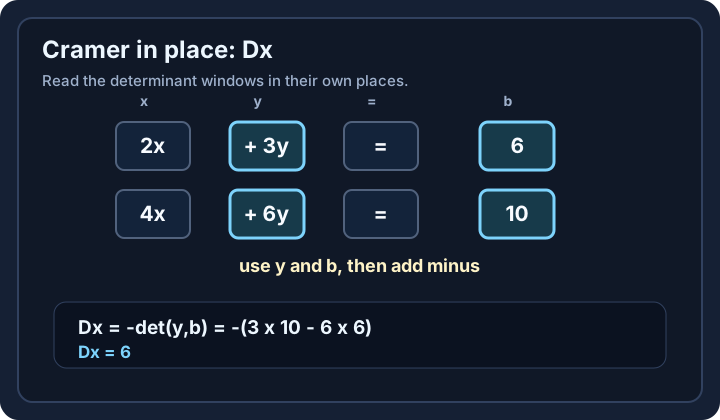
Read Cramer windows in place
For small systems, determinant windows reduce column-swapping in your head.
- 1Compute D first.
- 2Read the Dx and Dy windows.
- 3Divide only after signs are checked.
Use carefully
This is best for clean 2-variable systems and answer checks, not every algebra problem.
3-variable caution
Keep the sign pattern visible
For 3x3 systems, signs are the main danger; make them visible before expanding.
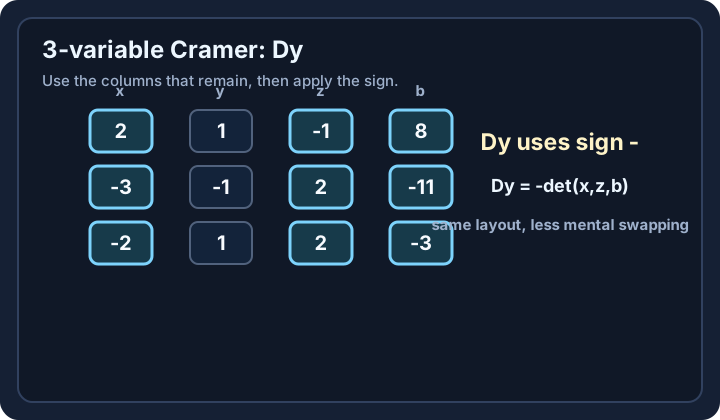
- 1Mark the cofactor signs.
- 2Expand through the cleanest row or column.
- 3Substitute only after D is stable.
Use carefully
If signs or numbers are crowded, switch to written work or elimination.
Mental arithmetic helps on a timed exam when it shortens a routine step or checks a result. It hurts when a complicated shortcut creates more risk than a clear written line. Because exam formats, calculator policies, and topic weights change, verify the current rules and official syllabus for your specific test before building a plan.
Build the reusable core
Across many quantitative exams, a compact foundation reduces friction:
- multiplication facts and integer signs;
- fraction, decimal, ratio, and percentage conversions;
- powers, roots, and common squares;
- one-step and two-step equations;
- estimates for products, quotients, and data values.
This is not the entire exam syllabus. It is the arithmetic layer underneath algebra, geometry, statistics, and word problems.
Use a four-move decision loop
For each calculation, train this order:
- Frame: What quantity and unit should the answer represent?
- Estimate: What range or sign is plausible?
- Compute: Choose mental work, a written method, or an allowed calculator.
- Check: Compare the result with the range and the original question.
Worked example: For 389 x 22, estimate 400 x 20 = 8,000. Then distribute: 389 x 20 + 389 x 2 = 7,780 + 778 = 8,558. The exact answer is slightly above the benchmark, as expected because the second factor is 22 rather than 20.
Train transformations, not a bag of tricks
A transformation is useful when you can state why it preserves the answer.
Worked example: If a ratio is 18:24, divide both terms by their greatest common divisor, 6, to get 3:4. If the question asks what percent 18 is of 24, the same relationship gives 18/24 = 3/4 = 75%.
This small chain is more reusable than memorizing a shortcut for one set of numbers. Likewise, compensation (497 + 286 = 500 + 286 - 3) and difference of squares (52 x 48 = 50^2 - 2^2) should be practised with their conditions attached.
Decide when mental work is not the best route
Use written work or an allowed calculator when:
- the numbers are easy to mistype or hard to retain;
- several signs or nested operations must remain visible;
- the question tests modeling or interpretation rather than raw arithmetic;
- an exact value is required and choices are close together.
Avoid treating calculator avoidance as a badge. The better question is which route is fastest to execute and easiest to verify under the actual rules.
Run a three-part practice cycle
Accuracy block: Solve one focused category without a timer. Require a written estimate or sign check.
Selection block: Mix ten short questions. Before each calculation, mark M, W, or C for mental, written, or calculator. Review whether the chosen route helped.
Timed block: Use a small set from official or syllabus-aligned material. Afterward, label every delay or miss as knowledge, setup, fact recall, sign, decimal, method choice, or reading.
The next session should target the largest error group, not simply repeat a random mixed set.
Measure what changes
Track accuracy, median time for a consistent problem type, number of corrected setup errors, and the error labels that recur. A faster set with lower accuracy is not progress. The aim is to make routine computation dependable enough that more attention remains for the reasoning the exam actually rewards.