
Estimation: A Practical Math Skill
Bracket the answer before exact calculation.
Estimate first
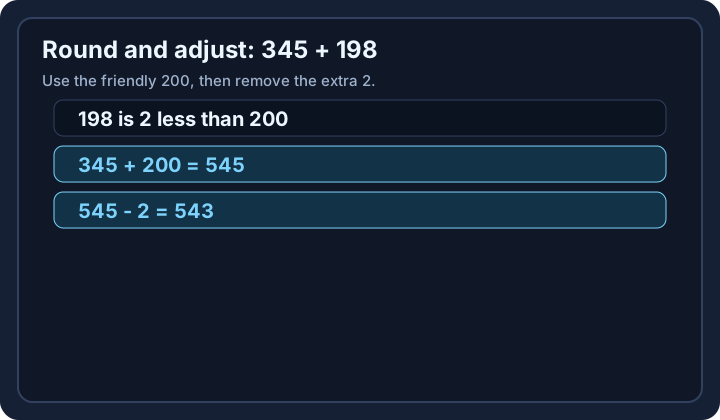
Round the noisy number, then correct
Rounding gives a fast bracket; the correction keeps the answer honest.
- 1Round 198 to 200.
- 2Compute the easy sum.
- 3Subtract the extra 2.
Use the bracket
Before correcting, notice the answer must be just under 545. That catches many input slips.
Division estimate
Use a nearby product to bracket the quotient
The nearest easy product tells you whether the quotient is too high or too low.
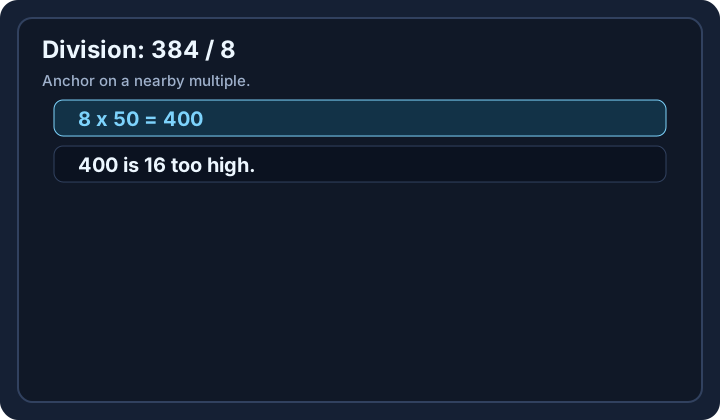
- 1Round to a nearby friendly dividend.
- 2Divide the friendly number.
- 3Adjust toward the exact quotient.
Answer range
Since 384 is below 400, the quotient must be below 50.
Estimation is controlled simplification, not a guess. A useful estimate tells you three things: an approximate value, whether it is likely high or low, and whether that accuracy is enough for the decision.
1. Rounding
Round one awkward value to a nearby place value, then track the direction of the change.
Worked example: 487 x 23 is close to 500 x 23 = 11,500. Because 487 was rounded up, the estimate is high. The exact product, 11,201, should be below it.
Rounding both factors can magnify error. If you change 487 x 23 to 500 x 20, the answer 10,000 is faster but much less informative.
2. Compatible numbers
Choose nearby numbers that divide or combine cleanly. This is especially useful for quotients and rates.
Worked example: Estimate 1,178 / 29 with 1,200 / 30 = 40. Check nearby products: 29 x 40 = 1,160, so the exact quotient is a little above 40.
The compatible pair should preserve the scale. Replacing 29 with 20 would make the division easy but distort the result.
3. Clustering
When several values lie near one center, multiply the center by the number of values instead of rounding each one separately.
Worked example: The prices $19.80, $20.40, $19.65, $20.10, and $20.25 cluster around $20. Five items cost about 5 x $20 = $100. The positive and negative differences mostly cancel, so this is a better estimate than rounding all five upward.
Clustering is not appropriate for a spread such as $8, $19, $27, and $46; those values do not share a meaningful center.
4. Front-end estimation with adjustment
Calculate the leading place values first, then add a small correction for the ignored parts.
Worked example: For $6.72 + $4.89 + $3.41, the whole-dollar front end is $6 + $4 + $3 = $13. The remaining cents total about $0.70 + $0.90 + $0.40 = $2.00, so the adjusted estimate is $15. The exact total is $15.02.
This method is useful when you need a running total and cannot stop for exact addition after every item.
Match the estimate to the decision
| Decision | Useful precision | Suggested move |
|---|---|---|
| Is $25 enough for three roughly $8 items? | Nearest dollar | Clustering |
| Is a quotient near 4, 40, or 400? | Order of magnitude | Compatible numbers |
| Did a calculator product make sense? | A few percent | Round one factor |
| What is the cart total so far? | Nearest dollar | Front-end adjustment |
Practice and label the error direction
Estimate 398 x 51, 2,043 / 49, the sum 31 + 29 + 32 + 28, and $12.68 + $7.21 + $5.09. Beside each estimate, write high, low, or balanced, then calculate exactly. That label turns estimation into a check you can reason about instead of a number you merely hope is close.