
The Feynman Technique for Learning Math
Explain one method simply enough to reveal gaps.
Explain it simply
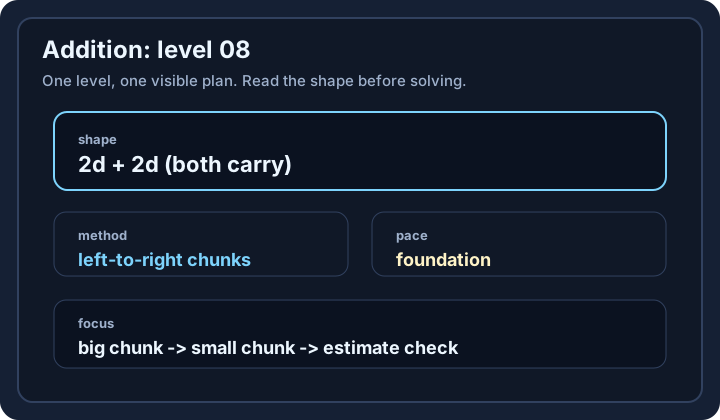
Teach one carry as raw windows
A good explanation names the window before naming the answer.
- 1Read tens: 6 + 5 = 11.
- 2Read ones: 8 + 7 = 15.
- 3Settle 11 | 15 into 125.
Gap signal
If the carry feels hidden, practice one answer-window example before moving on.
An explain-back loop, often called the Feynman Technique, turns "I recognize this" into a testable question: can I explain why each step is valid and use the idea on a new problem? In math, the explanation must include the operation, the reason for it, and the conditions under which it works.
Step 1: Choose one narrow idea
Do not explain "percentages" or "algebra." Choose something small enough for one example:
- finding 15% by splitting it into 10% and 5%;
- adding fractions with unlike denominators;
- completing the square;
- deciding whether a number is prime.
Write the question at the top of a blank page. Solve it without looking at notes first, so the explanation reflects what you can currently retrieve.
Step 2: Explain every transformation plainly
Worked example: Find 15% of 240.
"I split 15% into 10% and 5%. Ten percent of 240 is 24 because dividing by 10 moves from the whole to one tenth. Five percent is half of 10%, so it is 12. Adding the two parts gives 36."
That explanation is stronger than "move the decimal and halve" because it says what the decimal move represents. It also provides a check: 15% lies between 10% and 20%, so the answer must lie between 24 and 48.
Step 3: Mark the first weak sentence
Look for phrases such as "just do this," "it cancels," or "move it over." Replace them with a reason.
For the equation 3x + 7 = 22, saying "move 7 across" hides the operation. A precise version is: subtract 7 from both sides to keep the equation balanced, giving 3x = 15; then divide both sides by 3, giving x = 5.
If you cannot repair the sentence, return to one worked source, read only the missing part, close it, and explain again. Copying the source is not an explain-back.
Step 4: Test a nearby problem
An explanation may sound clear while being tied to one set of numbers. Change the surface details.
Worked example: After explaining 15% of 240, find 15% of 360. The same split gives 36 + 18 = 54. Then reverse the direction: 54 is what percent of 360? Since 54 / 360 = 0.15, the relationship still holds.
Use a four-question rubric
Before finishing, ask:
- Did I name the goal of the method?
- Did I justify each operation rather than only describe it?
- Did I state a boundary or common failure case?
- Could I solve a nearby problem without the notes?
A ten-minute practice format
Spend two minutes solving, three minutes explaining, two minutes repairing the weakest sentence, and three minutes on a nearby problem. Save only the repaired explanation and the new example.
The result does not need to sound polished. Its job is to reveal the exact point where understanding ends, then give you a small problem that proves the gap has been repaired.