
How to Square Two-Digit Numbers Mentally
Choose the squaring pattern before multiplying.
Think in windows
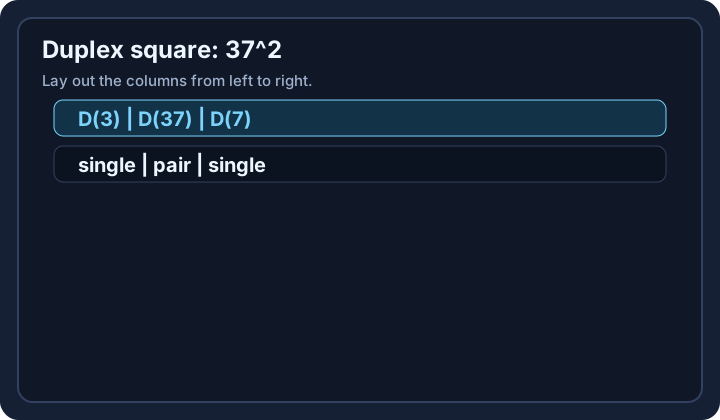
Square a two-digit number with the same-factor train
For 37 squared, use the ordinary 37 x 37 multiplication windows.
- 1Read 37 squared as 37 x 37.
- 2Fill the left edge, center window, and right edge.
- 3Settle the raw strip once and read 1369.
Common slip
Do not treat the raw middle column as a digit. Normalize the carries before reading the answer.
Center pre-training
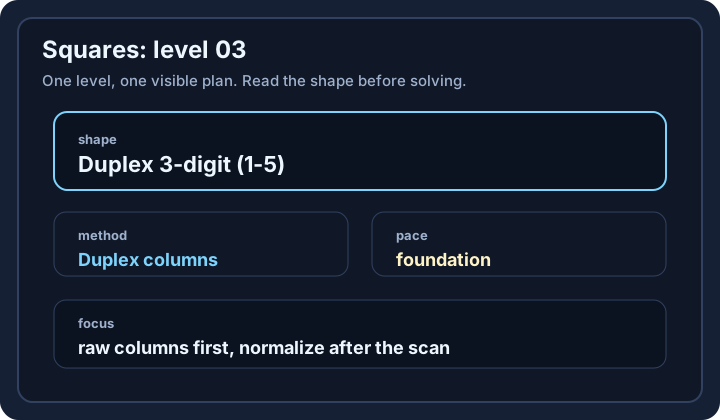
Learn the center stack before the full train
The center of 132 x 132 contains every product whose digit positions meet in the middle.
- 1Pair the outer digits in both directions.
- 2Include the middle digit times itself.
- 3Add the three products to get the raw center total, 13.
Mind the carry
Keep each raw part visible until the final carry pass; early carrying causes most slips.
There is no single fastest way to square every two-digit number. Choose a method from the number's shape. Each method below is an algebraic identity arranged to reduce the amount you need to hold in memory.
1. Numbers ending in 5
If a number is 10a + 5, multiply a by the next integer and append 25.
Worked example: 65^2 starts with 6 x 7 = 42, so 65^2 = 4,225.
This follows from (10a + 5)^2 = 100a(a + 1) + 25. Keep the ending as two digits: 15^2 is 1 x 2 | 25 = 225, not 2,025.
2. Numbers near 50
Write the number as 50 + d and use (50 + d)^2 = 2,500 + 100d + d^2. The middle adjustment is easy because it is 100 times the distance from 50.
Worked example: 47^2 = (50 - 3)^2 = 2,500 - 300 + 9 = 2,209.
For a number above 50, the sign changes: 58^2 = 2,500 + 800 + 64 = 3,364.
3. Numbers near 100
For 100 - d, use (100 - d)^2 = 10,000 - 200d + d^2. This works well when the distance from 100 is small.
Worked example: 96^2 = (100 - 4)^2 = 10,000 - 800 + 16 = 9,216.
The result passes two fast checks: it is below 10,000, and a square ending in 6 must end in 6.
4. The general nearest-ten anchor
For any other two-digit number, choose a nearby multiple of 10 and use (a + d)^2 = a^2 + 2ad + d^2.
Worked example: 37^2 = (40 - 3)^2 = 1,600 - 240 + 9 = 1,369.
The common error is losing the factor 2 in the middle term. It is 2 x 40 x 3, not 40 x 3. For 73^2, either anchor works, but 70 is slightly cleaner: 4,900 + 420 + 9 = 5,329.
How to choose quickly
| Number shape | First choice | Mental load |
|---|---|---|
| Ends in 5 | Neighbor-product rule | One small product |
| Within about 10 of 50 | Anchor at 50 | Hundreds adjustment |
| Within about 10 of 100 | Anchor at 100 | Small deficit |
| Anything else | Nearest multiple of 10 | General expansion |
Practice with built-in checks
Square 25, 54, 93, and 78. Before exact calculation, bracket each result between consecutive tens squared. For example, 70^2 < 78^2 < 80^2, so the answer must lie between 4,900 and 6,400. Then check the final digit: numbers ending in 8 have squares ending in 4.
If two methods seem equally short, use both on one example. Agreement between independent methods is a stronger check than repeating the same arithmetic.