
Math Competitions: A Beginner's Roadmap
Start competition prep with the right first week.
Competition base
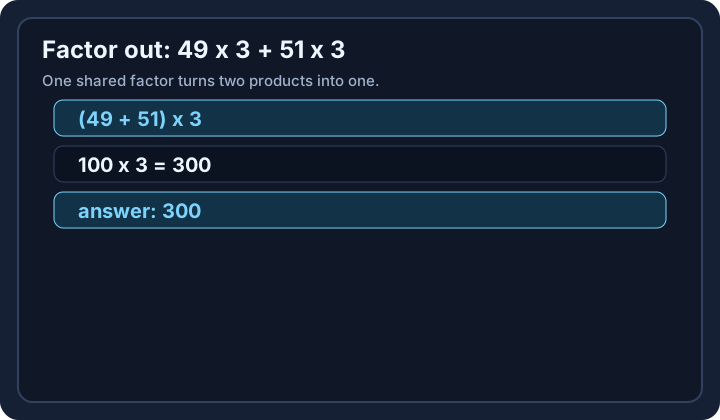
Factor shared structure before calculating
Many contest prompts hide a short path inside an expression that looks busy.
- 1Scan for shared factors.
- 2Group into a friendly sum.
- 3Multiply only after the structure is simple.
Roadmap use
Train structure spotting before speed drills; it pays off across algebra and number theory.
Matrix habit
Pick the least-work determinant route
Zeros and triangular structure should change the method before calculation starts.
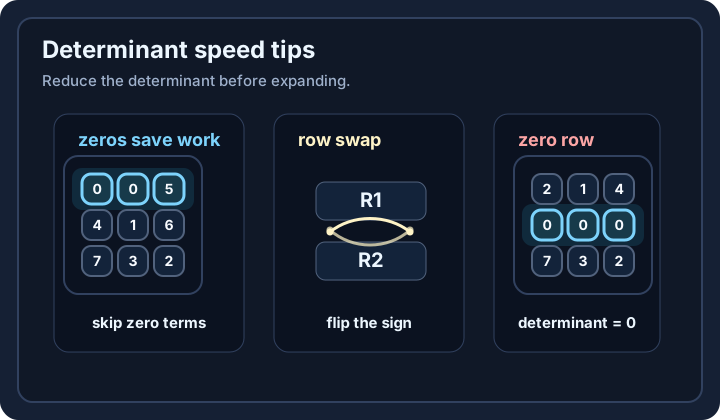
- 1Look for a zero row, zero column, or triangle.
- 2Choose the shortest route.
- 3Check signs before arithmetic.
Competition habit
Method selection often saves more time than faster arithmetic.
A beginner does not need to learn every contest topic at once. The first roadmap should connect four kinds of work: reliable foundations, one topic at a time, unfamiliar problems, and honest review. Adjust the plan to the official syllabus, age division, format, and rules of the competition you actually intend to enter.
Week 0: Pick the target and take a baseline
Find the organizer's current syllabus and one representative past set. Without studying first, try a small sample under relaxed conditions. Label each question:
- solved with a clear method;
- understood but calculation failed;
- topic not yet learned;
- no useful first move.
This separates a knowledge gap from a problem-selection or arithmetic gap. Keep the baseline; repeat a comparable sample later.
Weeks 1 and 2: Stabilize the foundations
Prioritize operations that appear inside harder questions: factors and multiples, fractions, ratios, percentages, integer signs, simple equations, and careful counting.
Worked example: 49 x 3 + 51 x 3 looks like two products, but the shared factor gives (49 + 51) x 3 = 100 x 3 = 300. The contest skill is noticing structure before calculating.
Use short drills for errors that consume attention, but do not turn every session into speed work. A learner also needs untimed problems where the first move is not announced.
Weeks 3 to 5: Run topic cycles
Choose one topic for several sessions. A useful cycle is:
- Learn or review one core idea.
- Solve two direct examples.
- Solve three problems where the idea is not named.
- Compare solutions and record the shortest valid route.
- Revisit one missed problem after a day.
Possible beginner cycles include divisibility, parity, basic combinatorics, angle chasing, sequences, and algebraic factoring. Follow the target competition's scope rather than this list if they differ.
Weeks 6 and 7: Mix topics and practise selection
Use short past-problem sets. Before calculating, write a five-word plan such as "factor the shared term" or "count the complement." This exposes random trial-and-error and makes solution review more useful.
Worked example: To count two-digit numbers with at least one digit 7, count the complement. There are 90 two-digit numbers. There are 8 x 9 = 72 with no 7: eight choices for the tens digit and nine for the ones digit. The answer is 90 - 72 = 18.
After each set, sort misses by topic, first move, execution, or time choice. The largest group sets the next practice target.
Week 8: Rehearse the real format
Use the official time limit and allowed materials. Practise decisions as well as solutions: when to continue, when to mark a question for return, and how much checking the format permits. Do not invent rules from another competition.
Keep a solution-review card
For every important miss, record:
| Prompt in one line | First useful observation | Why my route failed | Nearby problem |
|---|---|---|---|
| Shared products around 50 | Both terms contain 3 | Calculated separately | 38 x 7 + 62 x 7 |
Copying a full official solution can hide the decision that mattered. Reduce the review to the observation that unlocked the problem, then prove it transfers on a nearby example.
At the end of eight weeks, compare a new representative set with the baseline. The useful measures are questions understood, first moves found, recurring error labels, and solutions you can now explain. Those results determine the next cycle.