
Mental Math for Everyday Life: Shopping, Tipping, and Budgeting
Estimate money decisions before reaching for a calculator.
Money estimate
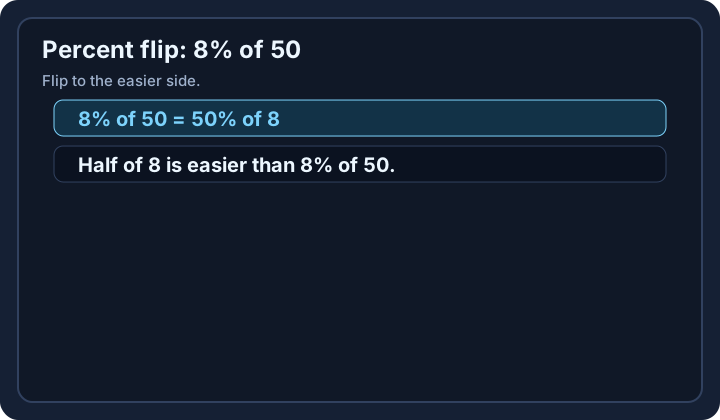
Flip percentages when the other side is easier
Percent questions often become simpler when you swap the percent and the base.
- 1Ask whether the flipped version is easier.
- 2Use halves, quarters, or tenths.
- 3Check that the size of the answer makes sense.
Good use case
Use this for tips, discounts, and quick comparisons where an estimate is enough.
Discount check
Track the product before shifting
A percent answer is a product with two decimal places moved at the end.
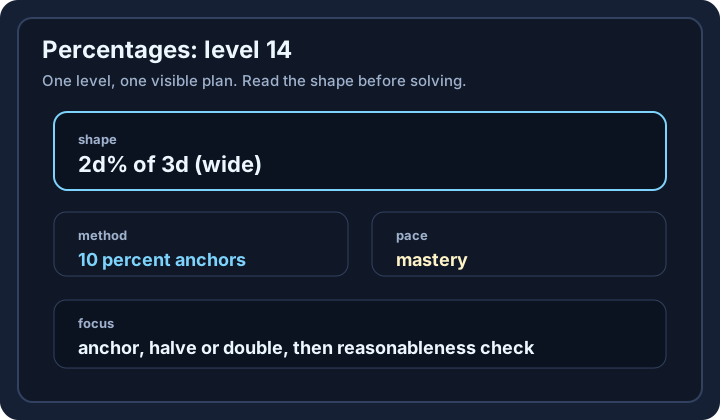
- 1Compute 16 x 436 first.
- 2Shift 20976 into 209.76.
- 3Compare with one fifth of 436.
Money check
If the percent is below 20%, the answer should be clearly below one fifth of the whole.
Everyday mental math is less about exact speed than about keeping the amount, direction, and unit visible. Estimate first when a quick range is enough; calculate exactly when money will actually change hands.
Discounts: separate the amount off from the price paid
Worked example: A $80 item is 35% off. Split 35% into 30% and 5%: $24 + $4 = $28 off. The sale price is $80 - $28 = $52.
State which number you have. $28 is the discount, not the final price. If tax applies, it is a separate calculation based on local rules.
Successive discounts do not add directly. A 40% discount followed by another 20% discount changes $100 to $60, then to $48. The total reduction is 52%, not 60%, because the second discount uses the smaller price as its base.
Tips: build from 10%, 5%, and 1%
Worked example: For a $46.50 bill, 18% is 10% plus 8%. Ten percent is $4.65; 8% is $3.72; the tip is $8.37, and the total is $54.87.
Use 20% as a check: 20% of $46.50 is $9.30, so an 18% tip must be a little lower. Tipping customs and whether tax is included vary, so decide the base before calculating.
Bill splits: divide the shared base, then add exceptions
Worked example: An $86.40 total split equally among four people is $21.60 each. Check by doubling twice: $21.60 x 2 = $43.20, and doubling again returns $86.40.
An equal split is only appropriate if the group has agreed to it. If one item is not shared, remove or assign that item before dividing the common amount.
Budgets: track the remaining amount, not only spending
Suppose the flexible monthly amount is $1,250, and $420, $185, and $96 have been used. Round first: about $400 + $200 + $100 = $700, leaving roughly $550. Exact subtraction gives $1,250 - $701 = $549.
The estimate catches a misplaced digit and answers the immediate question: is the remaining amount closer to $50, $500, or $1,000?
Unit prices: normalize both quantity and currency
Worked example: A 750 g pack costs $6.75. Since 750 g is 0.75 kg, the unit price is $6.75 / 0.75 kg = $9.00 per kg. A 1 kg pack at $8.80 is cheaper by $0.20 per kg.
Compare like with like. $6.75 is a lower package price, but not a lower price per kilogram. Quality, waste, and the amount actually needed can still matter more than the unit price.
A checkout checklist
Before accepting a result, ask:
- Is this the discount, tip, share, remaining budget, or unit price?
- What is the base amount?
- Are the currency and quantity units attached?
- Should the exact value be above or below the estimate?
Practise with one real receipt: estimate a discount or total, calculate it exactly, then compare the difference. The useful skill is a reliable range plus a clear unit, not mental bookkeeping for its own sake.