
5 Mental Math Tricks for Faster Calculations
Pick one shortcut and run a two-minute drill.
Try the shortcut
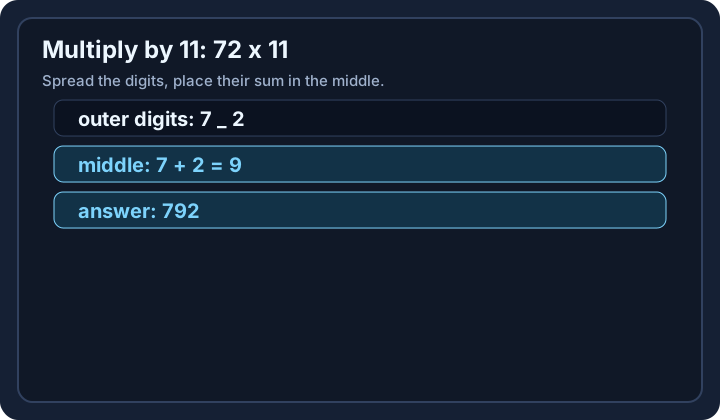
Multiply by 11 without a column setup
Keep the outside digits, add the middle pair, then carry only if needed.
- 1Place the first digit, 7.
- 2Add the two digits for the middle: 7 + 2 = 9.
- 3Place 2, then check against 72 x 10 + 72.
Why it works
Multiplying by 11 is multiplying by 10 and adding the original number once more.
Carry check
Bridge a sticky addition through ten
When the units feel crowded, complete ten first and carry only the leftover part.
- 1Use 3 from 8 to make 10.
- 2Keep the leftover 5 visible.
- 3Read 10 + 5 = 15.
When to use it
Use complements when a units carry is likely but the next ten is easy to reach.
Fast mental arithmetic is mostly method selection. The aim is not to memorize a trick for every number. It is to notice when one of a small set of structures makes the work shorter, then check the answer with a second view.
1. Multiply a two-digit number by 11
For a two-digit number 10a + b, multiplying by 11 gives 100a + 10(a + b) + b. That is why the outside digits stay in place and their sum fills the middle.
Worked example: For 68 x 11, start with 6 | 14 | 8. The middle is larger than 9, so carry 1 left: 6 | 14 | 8 = 748.
Quick check: 68 x 10 + 68 = 680 + 68 = 748. This method is useful only when the carry is handled explicitly.
2. Round and compensate
Replace an awkward number with a nearby friendly one, calculate, then undo the change.
Worked example: 347 + 198 = 347 + 200 - 2 = 545.
The same idea works for multiplication: 63 x 19 = 63 x 20 - 63 = 1,260 - 63 = 1,197. Before finishing, note that the exact product must be a little below 1,260.
3. Double one factor and halve the other
In a product, doubling one factor and halving the other keeps the result unchanged. Use it when one factor is even and the transformed pair becomes easier.
Worked example: 25 x 48 = 50 x 24 = 100 x 12 = 1,200.
Stop if halving creates an awkward decimal. For 35 x 27, this move does not simplify the pair, so distribution is clearer: 35 x (30 - 3).
4. Split an unfamiliar percentage
Build a percentage from parts you can calculate reliably, such as 10%, 5%, 1%, halves, or quarters.
Worked example: To find 17% of 240, use 10% + 5% + 2%: 24 + 12 + 4.8 = 40.8.
Quick check: 20% of 240 is 48, so 17% must be below 48. Keep the unit attached: a 17% discount on a $240 item is $40.80, while the sale price is $199.20.
5. Use a difference of squares
When two factors are equally far from the same center, use (a + d)(a - d) = a^2 - d^2.
Worked example: 53 x 47 = (50 + 3)(50 - 3) = 50^2 - 3^2 = 2,500 - 9 = 2,491.
This is a poor choice when the factors do not share a convenient midpoint. Do not force 54 x 41 into the pattern; round and compensate or use ordinary multiplication instead.
A five-minute practice ladder
- Solve
72 x 11and86 x 11. - Solve
489 + 297and42 x 99by compensation. - Solve
16 x 75by doubling and halving. - Find 18% of 150 by splitting the percentage.
- Solve
62 x 58as a difference of squares.
For every answer, write a one-line estimate. A shortcut earns its place only when it is both shorter and easy to verify.