
SAT Math: When Mental Arithmetic Still Helps
Use mental checks alongside the digital SAT calculator.
Exam check
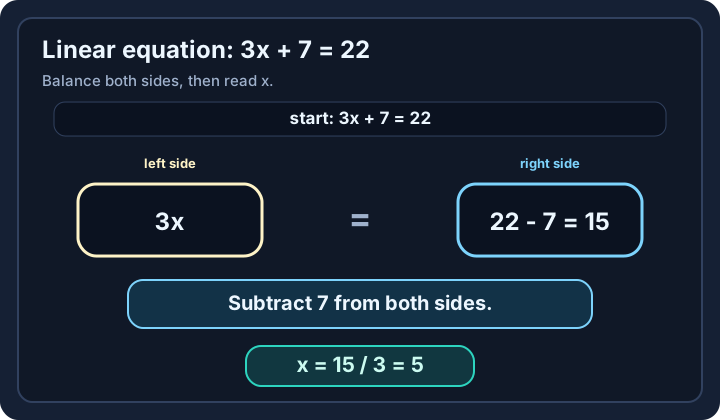
Solve the small equation before choosing
Mental algebra is safest when each move is reversible and visible.
- 1Move constants first.
- 2Divide by the coefficient.
- 3Substitute once to catch sign mistakes.
Exam use
Use this for simple linear prompts, answer checks, and quick elimination before spending time on a full setup.
System check
Use determinant ratios for small systems
If the system is clean, compute D first and replace only the target column.
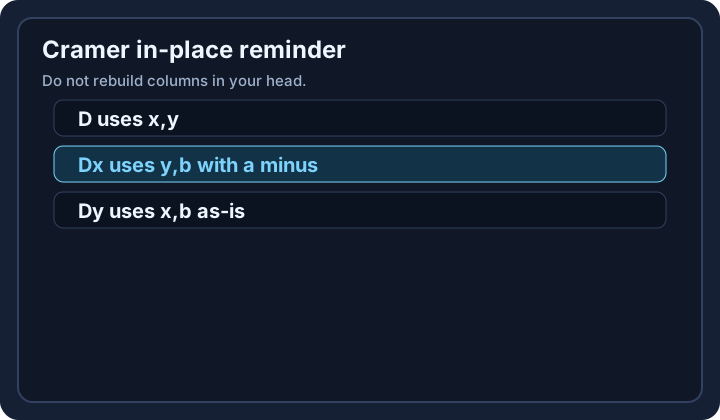
- 1Compute the coefficient determinant.
- 2Replace the target column with constants.
- 3Divide and substitute once.
When to skip it
If the system is messy, elimination may be safer than mental determinants.
The current digital SAT allows a calculator throughout the Math section. Bluebook includes scientific and graphing options, and College Board's current policy also describes which handheld calculators are allowed. Mental arithmetic still matters because it helps you choose a setup, reject impossible results, and avoid turning a one-line step into a long calculator entry.
Check the College Board calculator policy before test day. Rules and permitted devices can change.
Estimate before entering a calculation
An estimate gives the calculator result a range.
Worked example: For 489 x 0.23, use 500 x 0.25 = 125 as a nearby benchmark. The exact result is 112.47, which fits the expected scale. An entry such as 1,124.7 would reveal a decimal error immediately.
Use a one-sided check when possible. Because 0.23 is less than 0.25, 489 x 0.23 must be less than one quarter of 489, or 122.25.
Keep simple algebra on paper
Small reversible moves are often faster to write than to type.
Worked example: 3x + 7 = 22 becomes 3x = 15, so x = 5. Substitute once: 3(5) + 7 = 22.
This is not a rule against calculators. Graphing is useful for intersections, and bulky arithmetic deserves a reliable tool. The point is to avoid extra input when the algebra itself is the skill being tested.
Use answer choices as information
When choices are far apart, estimation may eliminate several without exact work. When they are values for a variable, substitution can be cleaner than deriving a full symbolic solution.
Worked example: If a positive quantity is 18% of 250, then 10% is 25 and 20% is 50. The answer must be slightly below 50; calculate 25 + 20 = 45 or use the calculator only after that range is known.
Do not rely on choice spacing alone. Student-produced responses have no options, and closely spaced choices require exact work.
Memorize a small conversion set
Fluent conversions reduce setup time and make estimates sharper:
| Fraction | Decimal | Percent |
|---|---|---|
1/2 | 0.5 | 50% |
1/4 | 0.25 | 25% |
1/5 | 0.2 | 20% |
1/8 | 0.125 | 12.5% |
3/8 | 0.375 | 37.5% |
These are anchors, not a demand to memorize every fraction. For 7/20, use 5/20 + 2/20 = 25% + 10% = 35%.
Practise with the actual test tools
College Board provides Bluebook practice tests and an official overview of the four Math content areas. During review, label each missed question as setup, concept, arithmetic, calculator entry, or time choice. Then change the matching behavior:
- Setup miss: translate the wording before calculating.
- Arithmetic miss: add an estimate or unit check.
- Calculator-entry miss: write the expression first, then enter it once.
- Time-choice miss: compare a mental route with the calculator route during untimed review.
The useful goal is not "calculator-free" performance. It is knowing when mental work is the shortest safe route and when the calculator genuinely reduces error.