

Speed Arithmetic: Build a Fast, Calm Routine
Build a calm speed routine with review built in.
Speed without rushing
Add by answer windows
Read one position, fill the raw strip, then settle carry once.
- 1Read hundreds: 1 + 2 = 3.
- 2Read tens: 5 + 3 = 8.
- 3Read ones raw: 6 + 7 = 13, then settle.
Review target
If a carry feels hidden, slow the final settle pass, not every window.
Round and adjust
Use a friendly number, then correct
Rounding makes the first move quick; the correction keeps the answer exact.
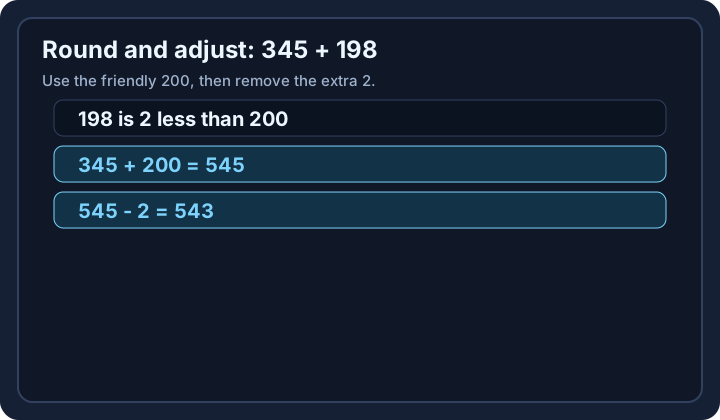
- 1Round 198 to 200.
- 2Add the friendly number.
- 3Subtract the extra 2.
Speed check
The final answer should be just below the rounded sum, not above it.
Arithmetic speed should mean less hesitation on a method you already understand, not hurried guessing. Build it with a stable problem type, a short measured set, and review that changes the next set.
Establish an untimed accuracy baseline
Solve ten representative problems with a written method and no timer. If errors cluster around one operation, place value, or carry, repair that issue before measuring speed.
Worked example: For 156 + 237, read raw answer windows: 1 + 2 = 3, 5 + 3 = 8, and 6 + 7 = 13. Settle 3 | 8 | 13 into 393. If the ones carry disappears, the practice target is carry cleanup, not faster addition in general.
Choose an accuracy threshold before adding a timer. For example, require at least 9 correct answers out of 10 on two untimed sets. The exact threshold can vary, but it should prevent repeated errors from becoming the rehearsed method.
Isolate one method
Keep the first measured sets narrow:
- two-digit addition with a ones carry;
- multiplication by 9 or 11;
- near-100 products;
- percent-to-decimal conversions;
- division by a one-digit factor.
Mixed sets are useful for method selection later. Early mixing makes it harder to tell whether a delay came from choosing the method or executing it.
Use a comparable timed set
Keep problem count and difficulty similar across attempts. Record total correct, total attempted, and completion time. A shorter time with more errors is not an improvement.
Worked example: For 345 + 198, round and adjust: 345 + 200 - 2 = 543. An estimate says the result should be just below 545. The method and the check should remain present when the timer starts.
Do not compare a set of easy facts with a later set full of carries and call the time difference progress. Use matched sets or compare several sessions of the same level.
Review by error code
For every miss or long pause, use one label:
| Label | What happened | Next drill |
|---|---|---|
| Fact | Basic result was not available | Smaller fact family |
| Carry | Raw value was correct but settling failed | Carry-only examples |
| Sign | Magnitude was right, sign was wrong | Signed pair set |
| Method | A longer route was chosen | Contrast two methods |
| Reading | A number or operation was copied incorrectly | Deliberate input check |
Redo the missed problem slowly, then solve two nearby examples. Repeating only the original can become answer memory rather than method repair.
A 15-minute routine
- Three minutes: Untimed warm-up with the chosen method.
- Five minutes: One measured set.
- Four minutes: Check answers and label misses or pauses.
- Three minutes: Solve a tiny set for the largest label.
On the next session, begin with that tiny set before returning to the matched measured set.
Read the right metric
Track accuracy first, then median seconds per correct answer across several comparable sets. Also track which error labels shrink. A single unusually fast attempt is weak evidence; a stable method with fewer pauses and preserved checks is the useful result.
Stop when the method becomes sloppy. The routine should train a clean first move, not reward continuing after attention has gone.