
Vedic Math Patterns for Mental Arithmetic
Use one named pattern without memorizing a long list.
Near-base method
Use deficits when both numbers sit near 100
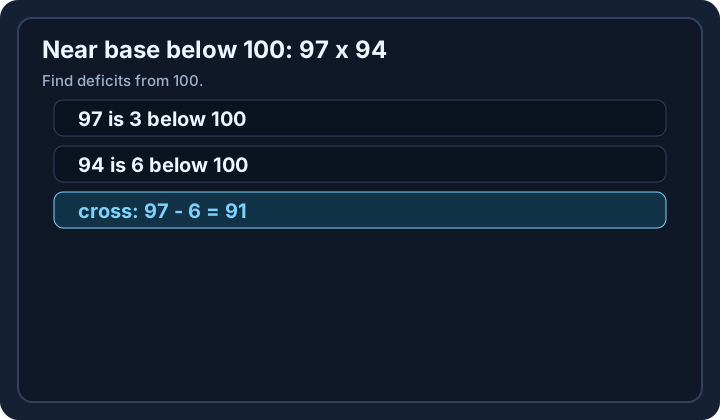
Turn 97 x 94 into two deficits from 100, then combine the cross-subtract and deficit product.
- 1Mark deficits: 97 is 3 short, 94 is 6 short.
- 2Cross-subtract to get 91.
- 3Multiply the deficits to get 18, then join the parts.
When to use it
Use this only when both numbers are close to the same base, such as 100 or 1000.
Crosswise method
Use train windows for two-digit products
Read left edge, cross window, and right edge before carrying the raw strip.
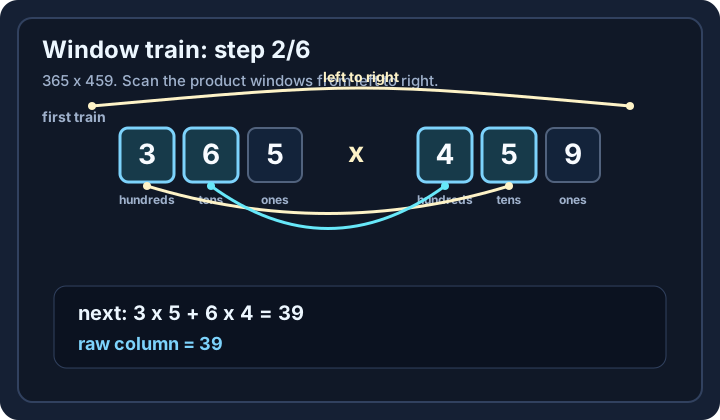
- 1Multiply the left edge.
- 2Add the two cross products.
- 3Multiply the right edge, then normalize.
Why the raw strip helps
Holding raw windows first keeps the thinking order clear; carrying is a final cleanup pass.
"Vedic mathematics" is commonly used as a label for a collection of calculation patterns. Historical claims around that label are separate from whether a method is valid. The three patterns here are useful because ordinary algebra explains them and makes their limits visible.
1. Near-base multiplication
Use this when both factors sit close to the same power-of-10 base, such as 100. Record each deficit, cross-subtract for the left block, and multiply the deficits for the right block.
Worked example: For 97 x 96, the deficits from 100 are 3 and 4. The left block is 97 - 4 = 93; the right block is 3 x 4 = 12. Therefore 97 x 96 = 93 | 12 = 9,312.
The right block must have as many digits as the base has zeros. Near 100, write two digits: 98 x 97 = 95 | 06 = 9,506. If the deficit product overflows, carry it into the left block rather than simply joining it.
Why it works: (100 - a)(100 - b) = 100(100 - a - b) + ab.
2. Crosswise two-digit multiplication
For (10a + b)(10c + d), calculate three raw windows: ac, then ad + bc, then bd. Normalize carries from right to left at the end.
Worked example: 42 x 37 gives raw windows 12 | 34 | 14 because 4 x 3 = 12, 4 x 7 + 2 x 3 = 34, and 2 x 7 = 14. Normalize from the right: 14 leaves 4 and carries 1; 35 leaves 5 and carries 3; the result is 1,554.
Keeping the raw windows visible prevents a carry from being mixed into the next multiplication. An estimate, 40 x 40 = 1,600, confirms the scale.
3. Squaring a number ending in 5
Multiply the tens part by the next integer, then append 25.
Worked example: 75^2: multiply 7 x 8 = 56, then attach 25, giving 5,625.
Why it works: (10a + 5)^2 = 100a(a + 1) + 25. The final block is always two digits, even for 15^2 = 225.
When these patterns are a bad fit
- Near-base multiplication is not efficient when the factors are far from the same base.
- Crosswise multiplication becomes crowded if you normalize carries before all raw windows are known.
- The ending-in-5 rule applies to squares, not to every multiplication involving a number ending in 5.
A short verification drill
Solve 94 x 98, 58 x 73, and 85^2. For each result, also write either a rounded estimate or a standard multiplication line. A pattern should reduce work without hiding why the answer is correct.