Skip to content

Learn

Curiosity Tracks

Why 1729 is special

The story of the smallest number that is the sum of two cubes in two different ways.

3 min read

A taxi cab ride

In 1918, the British mathematician G. H. Hardy visited his friend Srinivasa Ramanujan in hospital. Hardy mentioned he had taken cab number 1729 - "a rather dull number," he said, hoping it was not a bad omen.

Ramanujan disagreed

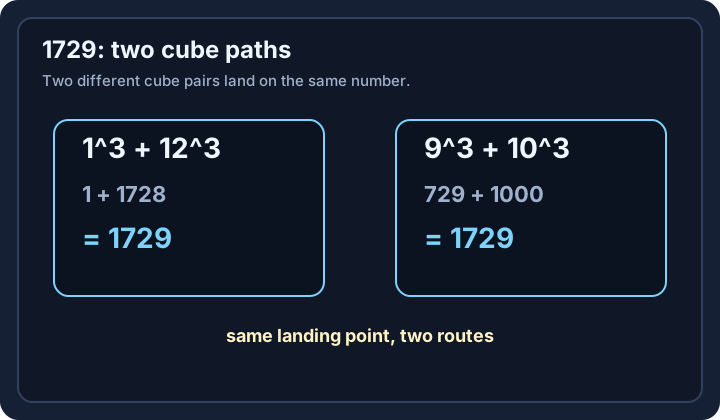
From his sickbed, Ramanujan replied: "No, Hardy, it is a very interesting number. It is the smallest number expressible as the sum of two cubes in two different ways."

The two ways

1729 = 1³ + 12³ = 1 + 1728 1729 = 9³ + 10³ = 729 + 1000 No positive integer smaller than 1729 has this property.

Why it sticks

It is the perfect example of how a number can look ordinary on the surface but hide a structure that only shows up when you look at it through the right lens. Mathematicians now call any number with this property a "taxicab number".

Try one yourself

The next taxicab number is 4104 = 2³ + 16³ = 9³ + 15³. Verify it in your head - addition + cube recall, both already in your Math Gym warm-ups.

More curiosity posts

We use cookies for analytics to improve your experience. Essential cookies for authentication are always active. Privacy Policy